

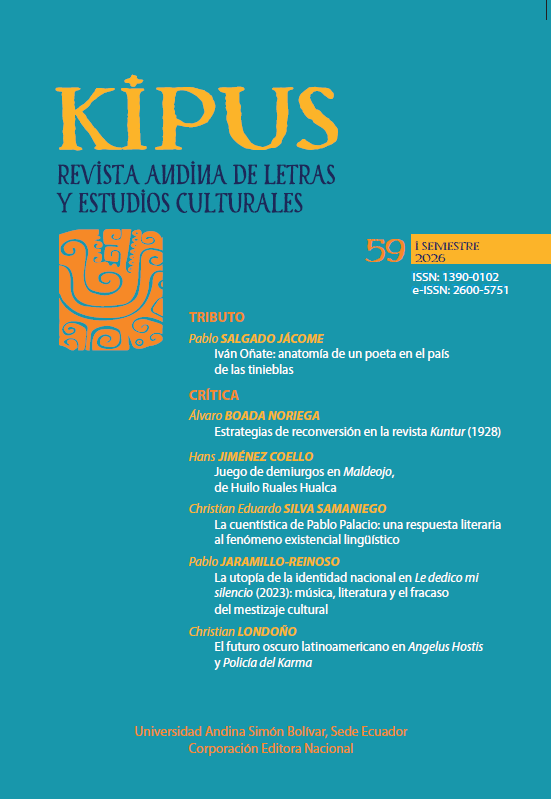
The Utopia of National Identity in Le dedico mi silencio (2023): Music, Literature, and the Failure of Cultural Mestizaje
Article Sidebar
Main Article Content

Abstract
This article analyzes how Le dedico mi silencio, by Mario Vargas Llosa problematizes national identity through criollo music and the failure of mestizaje in Peru. Using an interdisciplinary approach, the study examines the role of music as a symbol of an idealized nation, as well as the protagonist’s final silence as a metaphor for national disillusionment. The analysis is based on the theoretical contributions of García Canclini on cultural hybridity, Huyssen on memory, and Sarlo on the construction of national discourses. The findings suggest that Vargas Llosa not only offers a critique of the utopia of Peruvian identity but also reflects on the role of art in shaping collective memory.
Downloads
Article Details
Section

This work is licensed under a Creative Commons Attribution-NonCommercial-ShareAlike 4.0 International License.
How to Cite




References
Ackermann, Andreas. 2012. “Cultural Hybridity: Between Metaphor and Empiricism”. En Conceptualizing Cultural Hybridization: A Transdisciplinary Approach, editado por Philipp Wolfgang Stockhammer, 5-25. Berlín: Springer Heidelberg. https://doi.org/10.1007/978-3-642-21846-0_2.
Adorno, Theodor. 2003. Filosofía de la nueva música. Madrid: Ediciones Akal.
Altshuler, Daniel, y Christina S. Kim. 2024. “Towards a Typology of Narrative Frustration”. Topoi 43 (4): 1193-210. https://doi.org/10.1007/s11245- 023-09942-1.
Anderson, Benedict R. O’G. 2016. Imagined Communities: Reflections on the Origin and Spread of Nationalism. Londres: Verso.
Attali, Jacques. 1995. Ruidos. Ensayo sobre la economía política de la música. Ciudad de México: Siglo XXI.
Cornejo Polar, Antonio. 1998. “Mestizaje e hibridez: los riesgos de las metáforas. Apuntes”. Revista de Crítica Literaria Latinoamericana 24 (47): 7-11.
–––. 2003. Escribir en el aire. Lima-Berkeley: Latinoamericana Editores.
Delany, Samuel R., Sinda Gregory y Larry McCaffery. 1987. “The Semiology of Silence”. Science Fiction Studies 14 (2): 134-64.
Forgues, Roland. 2009. Mario Vargas Llosa. Ética y creación. Lima: Editorial Universitaria.
García Canclini, Néstor. 2024. Culturas híbridas. Estrategias para entrar y salir de la modernidad. Bogotá: Debolsillo.
Haines, Tasha. 2020. Redemptive Hybridism in Post-Postmodern Writing. Londres: Bloomsbury Publishing.
Huyssen, Andreas. 2003. Present Pasts: Urban Palimpsests and the Politics of Memory. Stanford: Stanford University Press.
Kholodniak, Olena. 2023. “Comparative literary theory: A cross-cultural approach to English literature”. Research Journal in Advanced Humanities 4 (4): 255- 73. https://doi.org/10.58256/rjah.v4i4.1317.
López Ramírez-Gastón, José Ignacio. 2015. “El extranjero íntimo: espacios imaginados y poscolonialidad durante la llegada del jazz al Perú”. En Música popular y sociedad en el Perú contemporáneo, editado por Raúl Romero. Lima: Pontificia Universidad Católica del Perú.
Martín-Barbero, Jesús. 2010. De los medios a las mediaciones. Comunicación, cultura y hegemonía. Barcelona: Anthropos.
Mijares, Loretta M. 2004. “Distancing the Proximate Other: Hybridity and Maud Diver’s Candles in the Wind”. Twentieth-Century Literature 50 (2): 107-40. https://doi.org/10.1215/0041462X-2004-3005.
O’Bryan, Jean. 1990. “El escritor y el hablador: en búsqueda de una identidad peruana”. Lexis 14 (1): 81-95. Paris, Bernard J. 1997. Imagined Human Beings: A Psychological Approach to Character and Conflict in Literature. Nueva York: NYU Press.
Sarlo, Beatriz. 2012. Tiempo pasado. Buenos Aires: Siglo XXI. https://www.academia. edu/16060443/Beatriz_Sarlo_Tiempo_pasado.
Sirojiddin, Pardayev. 2024. “The principles of cultural analysis of the artistic text”. American Journal of Philological Sciences 4 (1): 64-7. https://doi. org/10.37547/ajps/Volume04Issue01-11.
Steiner, George. 2013. Language and silence. Yale: Yale University Press.
Stockhammer, Philipp Wolfgang. 2012. Conceptualizing Cultural Hybridization. A Transdisciplinary Approach. Berlín: Springer Berlin Heidelberg.