

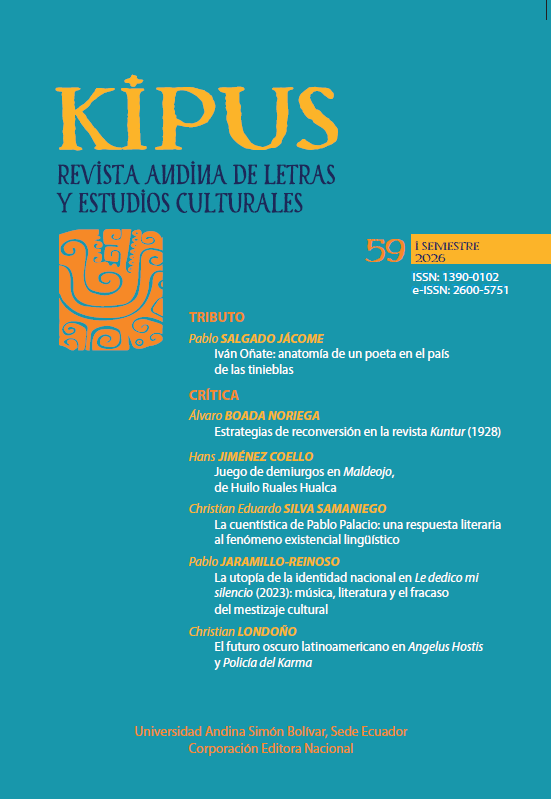
Reconversion Strategies in Kuntur Magazine (1928)
Article Sidebar
Main Article Content

Abstract
Kuntur magazine (1927) was a publication from the early 20th century that aimed to break away from the centralist order of the Peruvian capital and all the values it represented. To achieve this, it relied on various discursive mechanisms to confront the hierarchical structure symbolized by Lima. The aim of this paper is to show what those strategies were and what their purpose was in the last issue of the magazine. To address this objective, the study employs the notions of habitus and field developed by sociologist Pierre Bourdieu. Our hypothesis is that these mechanisms responded to an attempt to position Cuzco as a new cultural and symbolic center in opposition to Lima’s dominance.
Downloads
Article Details
Section

This work is licensed under a Creative Commons Attribution-NonCommercial-ShareAlike 4.0 International License.
How to Cite




References
Bourdieu, Pierre. 1995. Las reglas del arte. Barcelona: Anagrama.
–––. 1998. La distinción. Buenos Aires: Taurus.
–––. 2002. Campo de poder, campo intelectual. Barcelona: Montresor.
Calvi, Rosana. 2011. “Heterogeneidad de los discursos sobre lo indígena en las revistas indigenistas peruanas de vanguardia”. Tesis doctoral. Georgetown University. https://repository.digital.georgetown.edu/handle/10822/553234.
Casanova, Luis. 1928. “Kuntur y la juventud avanzada”. Kuntur 1.
Gutiérrez, Julio. 1986. Así nació Cuzco rojo. Lima: Perú Tarea. Kuntur. 1928. Grupo Ande.
Rozas, Óscar. 1928. “El problema del indígena”. Kuntur 2
Saavedra, Ramón. 1928. “Beligerancia Serrana”. Kuntur 1.
Valladares, Manuel. 2005. “Las letras que forjaron el indigenismo cusqueño”. Guaca 1 (2): 39-60.
Velazco, Luis. 1928. “Idearium andino”. Kuntur 1.