

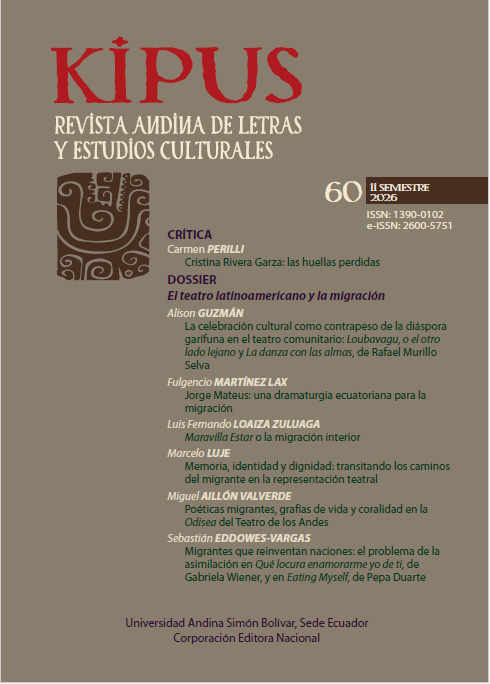
Cristina Rivera Garza: The Lost Traces
Article Sidebar
Main Article Content
Abstract
Autobiografía del algodón is a work of documentary fiction predicated upon a meticulous process of prospective and genealogical research. The autobiographical subject, as the title indicates, is cotton itself—a plant that encompasses lives shaped by the material and symbolic practices associated with cotton production. The relationship between humanity, the land, and its fruits is condensed in this attribution of animate agency to cotton. The testimonial weight of the work does not displace the imagination but rather harnesses its potential. Rivera Garza's stated intention is “to write in order to avenge those of mine relegated to oblivion and stereotype.” The text seeks to render an account of the drama of territory and migration, a drama that is equally one of displacement and ethnocide. In this peculiar autobiography, which is also a family biography, the author traces the footsteps of “climate refugees”—her Guachichil grandparents in northeastern Mexico and the southern United States.
Downloads
Article Details
Section

This work is licensed under a Creative Commons Attribution-NonCommercial-ShareAlike 4.0 International License.
How to Cite
References
Anzaldúa, Gloria. 1987. Borderlands/La Frontera. The New Mestiza. San Francisco: Aunt Lute.
Berger, John. 2010. Con la esperanza entre los dientes. Madrid: Alfaguara.
Braidotti, R. 2015. Lo posthumano. Barcelona: Gedisa.
Calveiro, Pilar. 2023. “Horror, violencias público-privadas y biopoder en el neoliberalismo”. Gramma (Universidad del Salvador) 34 (71).
Didi-Huberman, Georges, Jordi Barrios y Eliza Mizrahi. 2021. Los ojos de la historia. Ciudad de México: Universidad Iberoamericana.
Farge, Arlette. 1991. La atracción del archivo. Valencia: Edicions Alfons el Magnanim/IVEI.
Gerber Bicecci, Verónica. 2020. “Escritura del Compostaje”, entrevista realizada por Nona Fernández. Cátedra Abierta en homenaje a Roberto Bolaño. https://www.youtube.com/watch?v=DTGBJjBXYCo.
Giorgi, Gabriel. 2020. “Temblor del tiempo humano: política de la novela en Juan Cárdenas”. Cuadernos de Literatura 24. https://doi.org/10.11144/Javeriana.cl24.thpn. DOI: https://doi.org/10.11144/Javeriana.cl24.thpn
González Echevarría, Roberto. 2000. Mito y archivo. Una teoría de la narrativa latinoamericana. Ciudad de México: Fondo de Cultura Económica.
Gordillo, Gastón. 2018. Los escombros del progreso: ciudades perdidas, estaciones abandonadas y deforestación sojera en el norte argentino. Buenos Aires: Siglo Veintiuno Editores.
Montaldo, Graciela. 2024. “Imaginar y documentar: la doble vida del arte”. Revista Heterotopías 7 (13): 1-18.
Montoya, Pablo. 2017. Tríptico de la infamia. Buenos Aires: Literatura Random House.
Pratt, Mary Louise. 1997. Ojos imperiales. Literatura de viajes y transculturación. Buenos Aires: Universidad Nacional de Quilmes.
Revueltas, José. 2014 [1943]. El luto humano. Ciudad de México: Ediciones Era.
–––. 2015. Dolerse. Textos desde un país herido. 2.ª ed. Ciudad de México: Surplus.
–––. 2020. Autobiografía del algodón. Barcelona: Penguin Random House.
–––. 2022. Escrituras geológicas. Madrid: Iberoamericana y Vervuert.
–––. 2024. Escribir con el presente: archivos, fronteras y cuerpos. Ciudad de México: El Colegio Nacional.
Speranza, Graciela. 2012. Atlas portátil de América Latina. Madrid: Anagrama.
Taboada Hernández, Marco Polo. 2024. “Las huellas de la heterogeneidad narrativa en Autobiografía del algodón (2020), de Cristina Rivera Garza”. Escritos 32 (68). DOI: https://doi.org/10.18566/escr.v32n68.a01
Valenzuela Arce, José Manuel, coord. 2014. Transfronteras: fronteras del mundo y procesos culturales. Tijuana: El Colegio de la Frontera Norte.